
Travel's split-screen reality
Notes from Mexico and a chaotic world: asking who gets to feel safe and choosing to pay attention

I’ve spent two months (ish) in Mexico so far. The first month was spent in Mexico City, where I took Spanish classes every day, cycled between bustling neighbourhoods and parks, savoured various tacos and tlacoyos. Started to wrap my head around the immense 3,000 year history and culture of this country, from Mesoamerica to modern Mexico, that the world is tumbling in love with. February was spent on the move following a more typical travel style: nature, food, historical cities, many regional Pueblo Mágicos. All incredibly lovely. Lots to share on that soon.
Then two weeks ago, the leader of the CJNG (Jalisco New Generation Cartel) was killed in a raid by the Mexican Army. His followers reeled, instigating acts of larceny and highway blockades across the country. For me it was a sleepy Sunday, I woke up from a nap in my hotel room in Puebla city to the sounds of an American woman outside talking on the phone with someone afar who was checking in on their safety.
My colleagues and family sent similar texts of concern. We were fine, thankfully far away from the majority of the incidents. But we had travelled by bus on the Mexico Highway the day before, which was one of the roads now blockaded due to some vehicles set aflame. Guadalajara Airport closed temporarily, and schools suspended for two days in the states of Jalisco and Michoacán. We kept our eyes on the news, ready to change plans if the need arose.
A week before the death of El Mencho, I was sunning myself on the coast of Baja California Sur. Between my work days I ate fresh battered fish tacos and plates of spicy, citrusy aguachiles (prawn ceviche made with lime juice, chilies, cilantro, cucumber, and red onion). I snorkelled alongside whale sharks. Their gigantic 20 metre long bodies glided serenely in the shallow waters of La Paz Bay. My limbs were so slight in comparison.
I went SCUBA diving off the edge of Danzante Island in Bahía de Loreto National Park. Suspended 15 metres below the surface next to a volcanic-rock reef, I gazed at fluorescent orange nudibranchs and crimson sea stars, floated among schools of hundreds of sergeant major fish, and watched a sea turtle flipper away into the current. Another day, I kayaked around the same bay, admiring the desert-meets-ocean landscape from the top of a sheet of glass. Fish jumped up to break the illusion, pelicans soared low and nosedived near the pebbly shores. A humpback’s blowhole sprayed the horizon. I camped on a beach in front of low-lying sand dunes and fell asleep to the hush of waves under a cloudless, starry sky.
That too was Mexico.


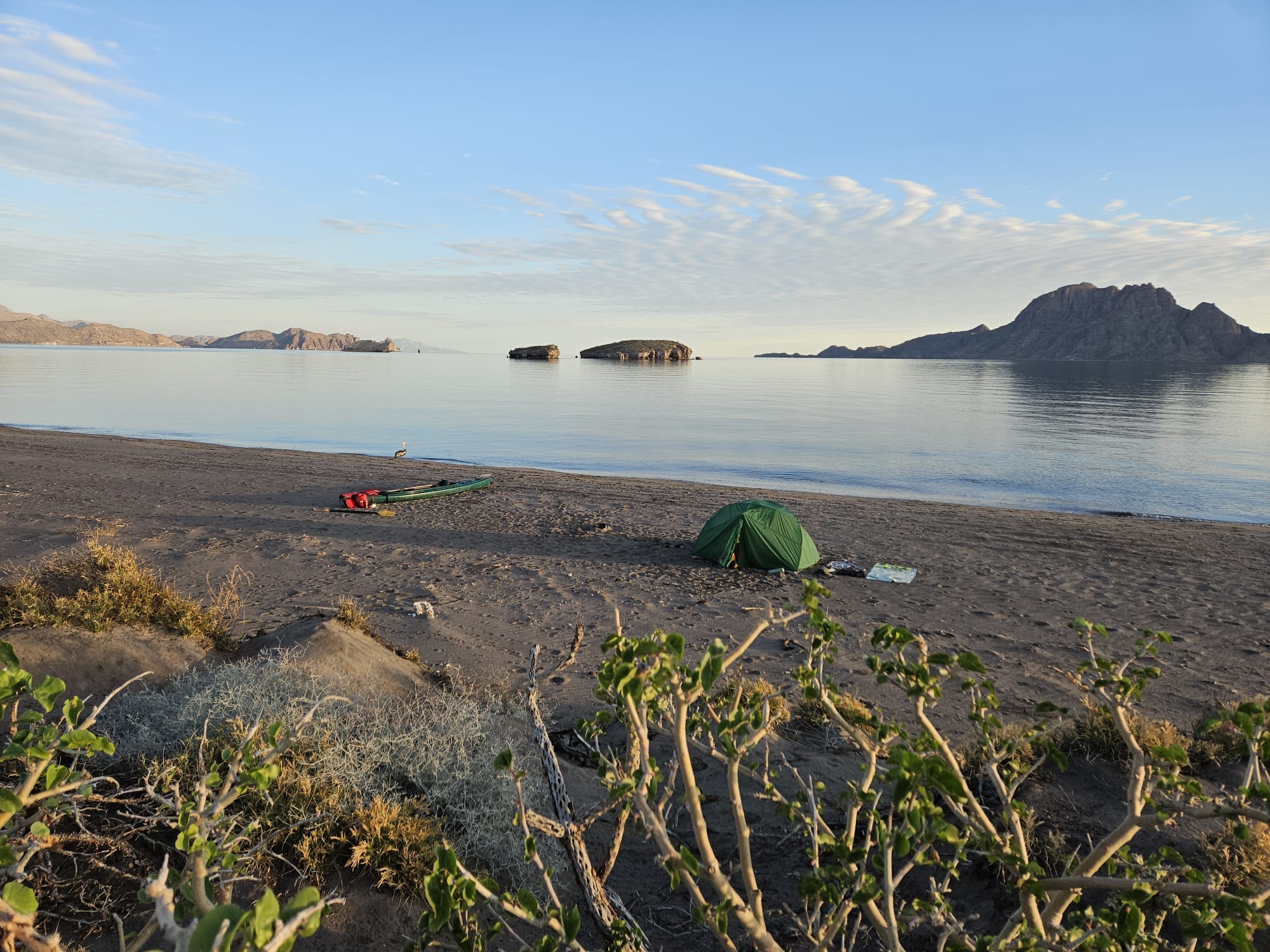
Split-screen realities
When you take the above two accounts together, it looks and feels quite discombobulating. CNN called it a “split-screen reality,” when Puerto Vallarta’s relaxed resort facade was shattered for American expats wintering there, that Sunday.
This kind of troubling event is not really new news. Nor is it singular to Mexico. As we all know the airspace across much of the Middle East is closed right now after the US and Israel illegally bombed Iran on March 1st, and Iran struck multiple sites across the UAE in retaliation. We’ve watched 700,000 people become displaced in southern Lebanon. I can only start to imagine the fear and stress travellers are going through in these places, let alone the local residents who’s permanent livelihoods are in immense danger. For whom the meaning of “safety” is likely different from my own.
In the middle of writing this newsletter, my algorithm gifted be Nadir Nahdi, who writes from the Gulf: I am safe, but not too sure I deserve to be? His words perfectly sum up what I have been reflecting on and provide a lot to consider.
In response to expats around him panicking, he writes: “Your fear is legitimate.
But your fear also reveals the map you’ve been given and who was left off it.
Some people grow up learning to trust the ground beneath them. We grow up knowing it can disappear. And moments like this expose that difference.”

I acknowledge I am very much in the first camp. It’s so easy to succumb to this privilege, to romanticise travel and to get absorbed in your own travel experiences. If you spend too much of your time flitting between museums and restaurants and nice accommodations with air conditioning and travelling via Ubers and airplanes, your eyes can start to turn rosy. I don’t usually travel that way — I’m writing this from a 7 hour interstate bus ride — but the point remains.
I don’t fear for my safety in this country and I’m not trying to add to any negative stereotypes about Mexico. I’m not travelling alone (not that solo travel is or should be dangerous for women). I’ve generally chosen to avoid what the Australian government would label dangerous zones, while still aiming to visit places beyond the main tourist circuits. My experiences and conversations with locals have been overwhelmingly positive.
But it’s all a timely reminder when you’ve been living in a small tourist bubble for even just a few days, like my Baja beach haven, that the place you are visiting is real. There are deep social, political and economic concerns that impact the people who live there permanently. The main concerns of my own visit should be: who benefits from it? Where do my tourist dollars go? What kind of impact does my being here have?
So if I were to feel fear, who should that fear really be for?


It has revealed to me, yet again, that we have a choice to pay attention or to bury our heads in the sand. Even as, especially as, visitors.
To quote Nahdi again: “You cannot opt out of the protection you were born into. Neither can I. But you can refuse to let that protection make you indifferent.”
What I do fear is the direction the world is heading. The indifference of my government in the face of relentless, too-powerful, genocidal world leaders. I fear the consequences of not paying attention. So I’m choosing to ask the difficult questions. I’m absolutely learning as I go. I hope on your next trip, or even within your own backyard, that you’ll join me.
If you have ideas for how to embrace this moral opportunity, or any experience in grappling with such events while travelling, I’d love to hear about it in the comments!
Veering is free to read. If you enjoy my posts and would like to support in some way, a simple like, share or comment on the post below will help my publication grow.
Or, you can buy me a coffee to help keep me motivated. Your support means a lot.
love this sooo much, especially the way graffiti art tells history in crumbling little walls.