
Moonlight dancing, magic towns and Mexican crocodiles
What happens when you take the long way around

If you were given the choice between a 1 hour 40 minute direct flight or a roughly 1,500km road journey, which would you take?
Those are your options if you want to travel from Mexico City to Mérida, the capital of Yucatán. Considering that Mexico City to Cancun, the Peninsula’s most famous destination, is the top single route for all domestic flights, my guess is most people choose to fly.
But aren’t they wondering what they might miss out on along the way?
It’s this question, and a desire to fly less this year, that prompts me to take over 30 hours of buses through Mexico’s east across three weeks.
Here’s some tales from the road.
A flying dance under the moonlight
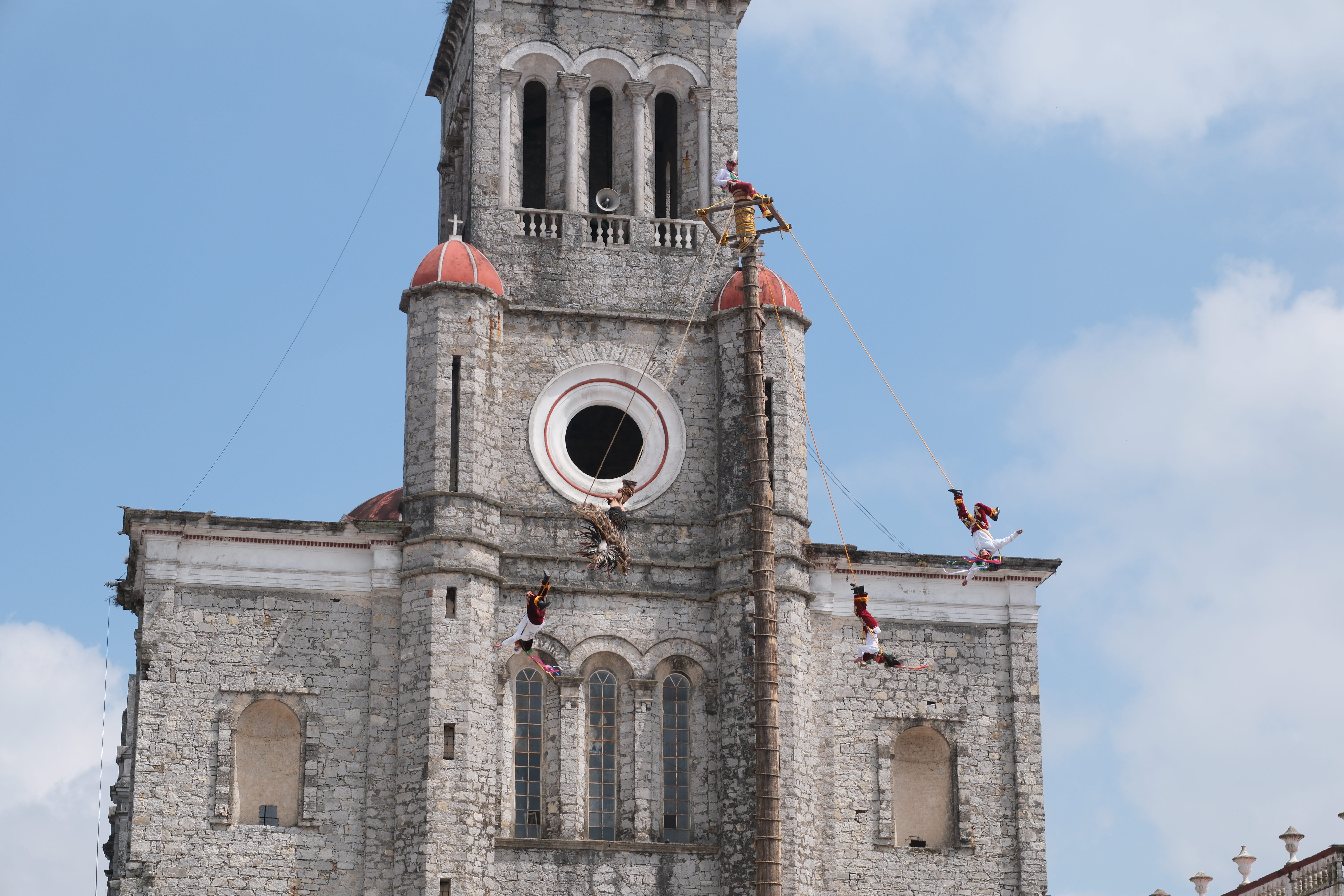
If we hadn’t chosen the bus life, I would never have found myself watching a centuries-old native Mesoamerican dance ritual - Danza de los Voladores - under a radiant full moon.
It’s here in Cuetzalan, on a calm Saturday evening, a cool breeze breaks the stifling heat. We’d spent the day basking in waterfalls and visiting the nearby archeological site Yohualichan. Now, loud drumming and a high pitched flute cuts through the murmur of people buying food and vendors milling up and down the stairs.
Villagers and visitors gather and sit around the large square in front of the town’s church. A large wooden pole, some thirty metres high, resides full time in the square. Here the native Nahua and Totanac people have practiced this dance and ritual (which translates to Dance of the Flyers in English) as an offering to the gods since ancient Mesoamerica. The ritual is said to have formed to ask the gods to end a severe drought, and evolved into being closely associated with solar ceremonies. Now it’s preserved as a UNESCO-recognised practice of intangible cultural heritage, and to share with tourists.
Four people dressed in tasselled red pants and white shirts sit suspended on a square-shaped wooden plank attached to the top of the pole. Thick rope is wrapped around each of their ankles. Perched on the very tip is another person decorated in a large plumed headdress. He’s playing the flute and drum. All of their costumes are impersonations of bird deities. My nerves spike at the precariousness of it.


The four seated dancers fling backwards in unison and steadily spin upside down and around like a carousel, the rope slowly unwinding and bringing them toward the earth. The flautist follows, together they all spin a total of 52 times to represent the number of years in the Aztec calendar.
We’d seen a similar ritual in Mexico City’s grand park Chapultepec, but performed using a large metal pole. It turns out only a few small villages still practice with the traditional tree trunk - Cuetzalan is one of them.
Artisan coffee, home-made crab soup and conversations with strangers
There’s no easy way in or out of Cuetzalan without a car. The night before we leave, I figure out that we can get to our next main destination, Xalapa in Veracruz, across three different buses and without back-tracking all the way to Puebla city. A winding road takes us through the countryside and small cities across the border to Veracruz.
Xalapa surprises me. One of my Spanish teachers had told me there wasn’t much to love about it. But this university city with pastel houses is brimming with excellent coffee shops, artistic spaces and formidable parks. Circling the Paseo de los Lagos by morning becomes a ritual during my week’s stay, while a walk through the cloud forest on the outskirts of central feels a far throw away from city life. By night we listen to jazz inside a hidden library, try all the local antojitos and cook up our own version of a Veracruz crab soup, made with fresh seafood come in from the nearby coast.


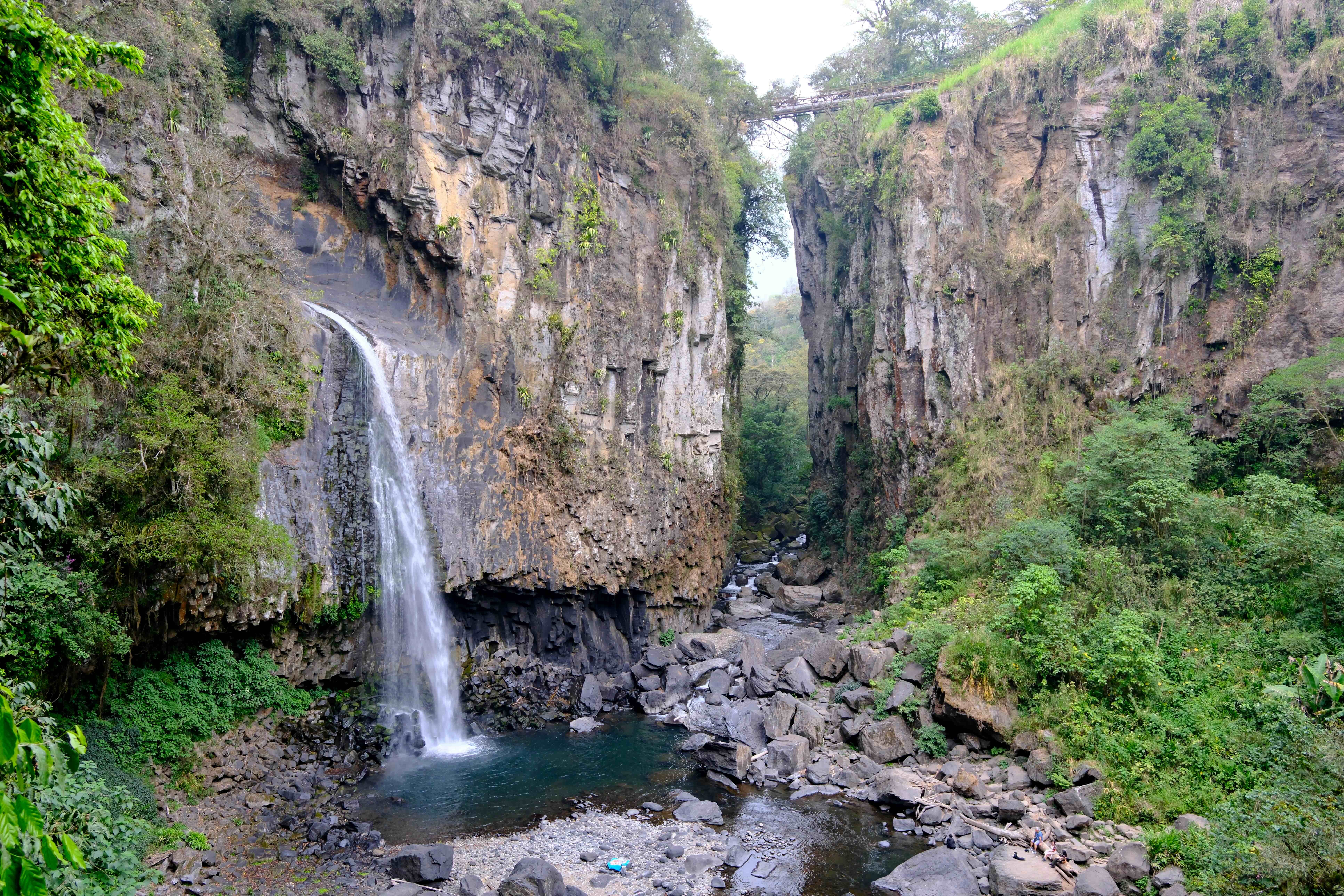
Even more joy comes from a day trip in Xico, another pueblo magico an hour from Xalapa, reached by a rattling local bus. A river borders the town, so naturally the first stop is a swim. Then we walk 4km outside of town to visit Cascada de Texolo. It’s down in the ravine we meet the landowner’s son, who spends his days guarding the waterfall, taking payment from visitors and ensuring no one gets hurt on the slippery, steep path down to the water or on the treacherous boulders.
After thirty minutes of fumbling conversation, comparing our ages and last name structures and how we swear in Australia, he says “we’ll meet again, and next time you come you will have excellent Spanish.”


Two days later in the neighbouring coffee town Coatepec, we meet Miguel, a retired man who now spends his time gardening in the nature reserve in the centre of the city. We’re hungry and wanting to grab food in town, but he waves us over as we’re walking down from the viewpoint. His low jeans expose his crack, a scythe is strapped to the front and a worn shirt is loosely buttoned. Between his big sombrero and his bushy beard, a broad gummy smile presents itself. “Conoces este arbol?”, (do you know this tree?) he asks us in Spanish.
I shake my head no, so he proceeds to take us on a short tour around the foliage, pointing out the native species and the way a row of long grass has been deliberately planted to prevent too much water gushing down the hill during the rainy season. We scrunch Mexican basil in front of our noses and something else akin to lemongrass. We yarn while he takes a seat on the sloped grass. Old Miguel has a love for macadamia nuts - has 20 of his own trees on his little ranch near the city- and studied Russian literature in Moscow for four years as a youth before starting his family, who he talks about with pride.
I think possibly this interaction has made both our day and his.
A crocodile farm deep in the mangroves
An overnight coach takes us to Tabasco, where we spend a morning in the capital city Villarhermosa, then we head on to Campeche city for a few working days. From there, we could choose a straightforward hour-long trip to travel from Campeche city to Merida.
But at the last minute we opt for a weekend at an eco-accommodation and crocodile farm in the remote Isla Arena, a small fishing village surrounded by protected mangroves and a lagoon within the Parque Natural Petenes-Ría Celestún. It’s quite the detour.
The first collectivo stops in Calkini, where it takes us almost an hour and asking more than 5 different people with mixed instructions before we find the bus stop to take us to Isla Arena. At last we find it: a dirt driveway tucked in from the main street; the workers assure us a bus is arriving soon.
Two hours later we’re in a minivan, hurtling along a straight dirt road into the reserve, passing through small rural villages as the crimson sky fades to darkness.
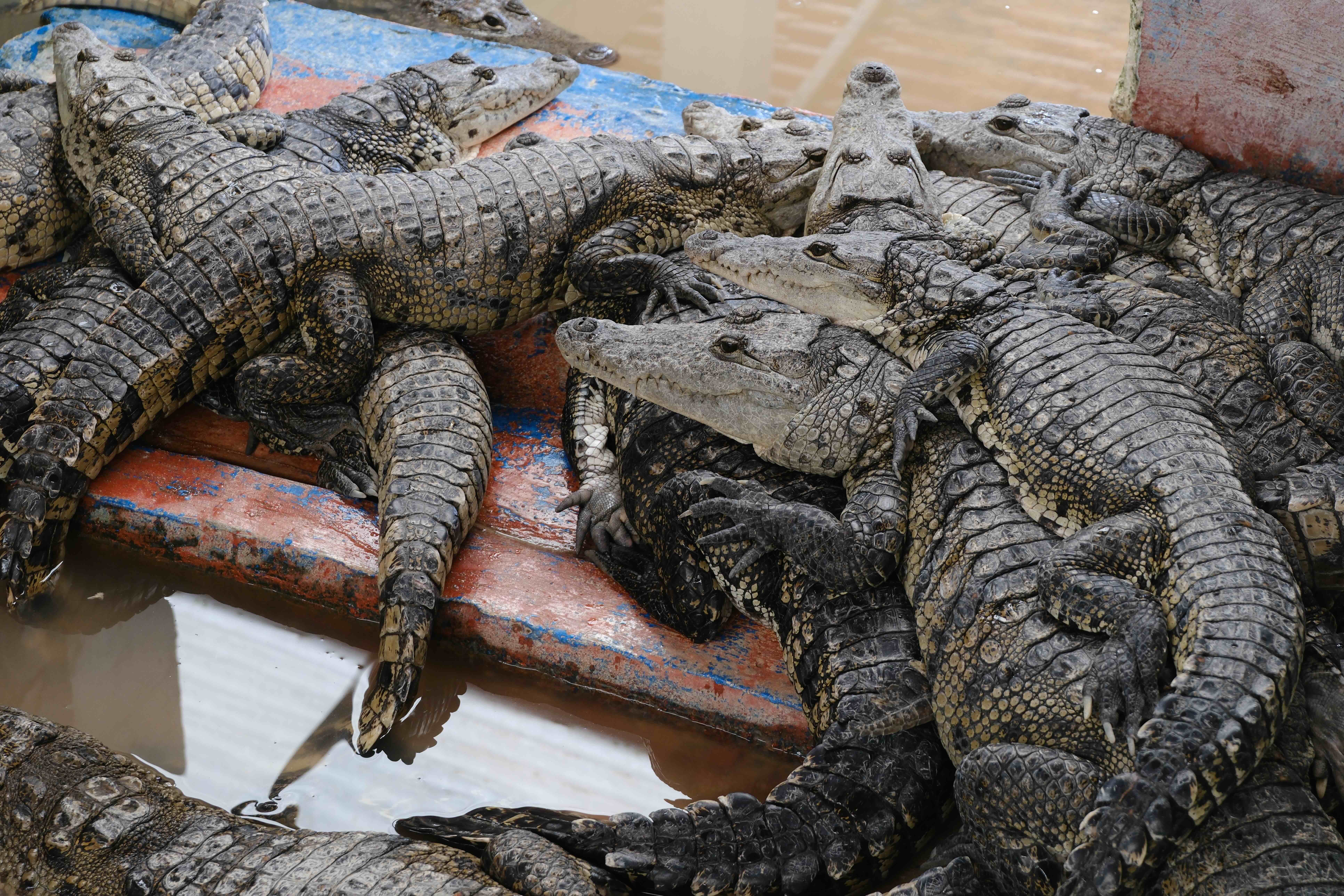
Wotoch Aayin is the Mayan family-run accommodation, restaurant and co-operative who manage and breed the Mexican or Morelet’s crocodiles (a smaller, less dangerous species than we’re used to in Australia). Through a tour with co-owner Sergio Lizama, we learn he started their project two decades ago when the Morelet were under threat from poaching. Now they have about 600 crocodiles, separated by age in different open-air enclosures. Though around 100 are killed to eat each year. The community here lives off crocodile, fish and octopus as their main protein sources, the only easy option considering the next town with agricultural land is more than 70km away.
Wotoch Aayin offers a relatively basic but comfortable way to spend time close to nature. By morning we kayak around the lagoon and inspect the four different mangrove species up close: their tentacled branches and roots provide homes for myriad fish, horseshoe crabs, water birds and even raccoons. I keep my eye out for pink flamingoes, but our timing is not quite right for their migrational patterns. Instead, green saplings sprouting from the mud capture my attention. A kingfisher takes flight in search of breakfast. We drift slowly while bird calls echo through the forest and tiny fish zoom rapidly just below the milky surface. This grove is a whole universe in itself, multiplying and filtering and storing carbon.
Jaguars and ocelets roam somewhere in the jungled forest across the bay, Sergio tells us. He also says the reserve’s name, “Los Petenes” means “circular place” in Maya and refers to the hundreds of cenotes found in the area.
In the pitch dark of night we follow a boardwalk through the mangroves now lit with fireflies, then sit on the pontoon and watch a thunderstorm unfold far beyond the water, one hundred kilometres away. It’s burly and magnificent.
Around 20 kilometres south is Celestún, another entrance to the bio-reserve and a very popular spot to see pink flamingoes. I’m told it’s quite established with tourist infrastructure like boat tours and restaurants.

By contrast, outside of Wotoch Aayin, Isla Arena feels like a place long-forgotten and neglected. Only two accommodations seem to be open (including ours). Others that perhaps once functioned are now empty and rusting in the salty sea air.
One night Sergio drives us down the bumpy potholed road through town at 9pm to buy some snacks from a small shop for dinner (all food places are already closed). He tells us the government doesn’t spend any money here. Because they’re in the reserve, a tarmac road can’t be built. Most houses are made from cinder block or make-shift pieces of tin and timber. Piles of trash linger along the road.
It demands a moment of pause. Tourism in Mexico seems to be fairly concentrated in a few key areas, and the outliers lose out significantly. A 2023 report said the closure of the Tourist and Cultural Complex was causing the Isla Arena economy to collapse. Locals said without tourists, fishermen can’t sell their fish to the restaurants, the shops too lack business. Their one hope was that the new train network, Tren Maya, would help revitalize the port’s economy. That all remains to be seen.
It reminds me of Emma Schneck’s great essay: what happens when the tourists stop coming? What then?


Leaning into discomfort and slowness
These meandering, long bus rides may sound tedious or risky. Apart from the fabulous major bus network which we take often, collectivos or minivans very rarely have a written timetable or information online.
In the vans, my skin sweats in the heat, yearning for air conditioning. My nose pricks at the acrid stench of burning rubbish when passing through the outskirts of towns. I can’t often read because it’s a little too bumpy.
But it gives me more time to just sit and notice. To stop in places I’d never heard of, interact a little more, ask questions of strangers and figure things out for myself.
I think this side of travel has been lost a little bit, what with many experiences being part of organised tours or a predefined list of “must-do’s”. We like to think we can be in control of all of the outcomes, to ensure we have a perfect trip. We don’t want to miss the thing that everyone else is doing. But this removes discomfort, it stifles curiosity and it makes travelling way too generic and easy.
Not everything is a hit. Sometimes the bus doesn’t come on time. Sometimes you’re squished into the backseat with no airflow.
But it’ll almost always give you something you didn’t expect. And that to me is always worth it.
Veering is free to read. But if my stories resonate with you and you’d like to support in some way too, a simple like, comment or share on my posts does wonders. Or you can contribute to my caffeine piggy bank below.
Forever the one that will choose the longer road. It was beautiful to read about your time in places that are quite unknown to many in Mexico, even us Mexicans. And it's really those interactions with people you come across that become so meaningful and expansive. It was beautiful to feel right there in those moments with you, what a blissful writing you have!
".... 1,500km road journey, which would you take?" – I would choose 200-300 kilometers on foot... Seriously.
And on the topic of the post: How much have you packed into this journey! I'm always afraid that my perception won't work... Therefore – on foot :)